A fascination that began in childhood
Long before I began thinking of myself as a documentary photographer, I was fascinated by the photographic essays published in Life magazine.
I remember being captivated by the extraordinary power of those photographs, particularly the black-and-white images that appeared throughout the middle decades of the twentieth century.
They introduced me to people, places, and circumstances far removed from my own experience. More importantly, they demonstrated that photographs could tell stories in ways that words alone sometimes could not.
A face, a gesture, an unexpected moment between people—these could reveal something about the human experience that needed little explanation.
The work of photographers such as W. Eugene Smith represented a tradition of photography that has continued to interest me throughout my life.
I was drawn not simply to the beauty of the images, but to their humanity.
I still am.
Learning to see
Photography has been an interest of mine for much of my life, although I never received formal photographic training or pursued it as a profession.
For many years, I travelled with a camera, photographing the places I visited and the people I encountered.
Much of that travelling was undertaken with family. The photographs were often made during journeys planned for reasons other than photography, and I seldom had the freedom to spend hours observing a particular place or waiting for a moment to unfold.
I did not necessarily think of those photographs as documentary work.
Looking back, however, I wonder whether my interests were already becoming apparent.
I was frequently drawn to people going about their ordinary activities, to streets and markets, and to the small moments of everyday life that might easily pass unnoticed.
Sometimes I was interested in the architecture or the colours of a place. Sometimes it was a person or an unexpected interaction that caught my attention.
I was not always conscious of why I wanted to take a particular photograph.
Perhaps that is something we discover about our photographs only later.
India and the unexpected encounter
My travels in India gave me opportunities to pursue these interests more deliberately.
I was drawn to the extraordinary diversity of everyday life: people working, travelling, worshipping, learning, gathering, playing, and simply going about their days.
I found myself increasingly interested in the people I met and the circumstances of their lives.
Some encounters lasted only a few moments. Others led to conversations or experiences that remained with me for years.
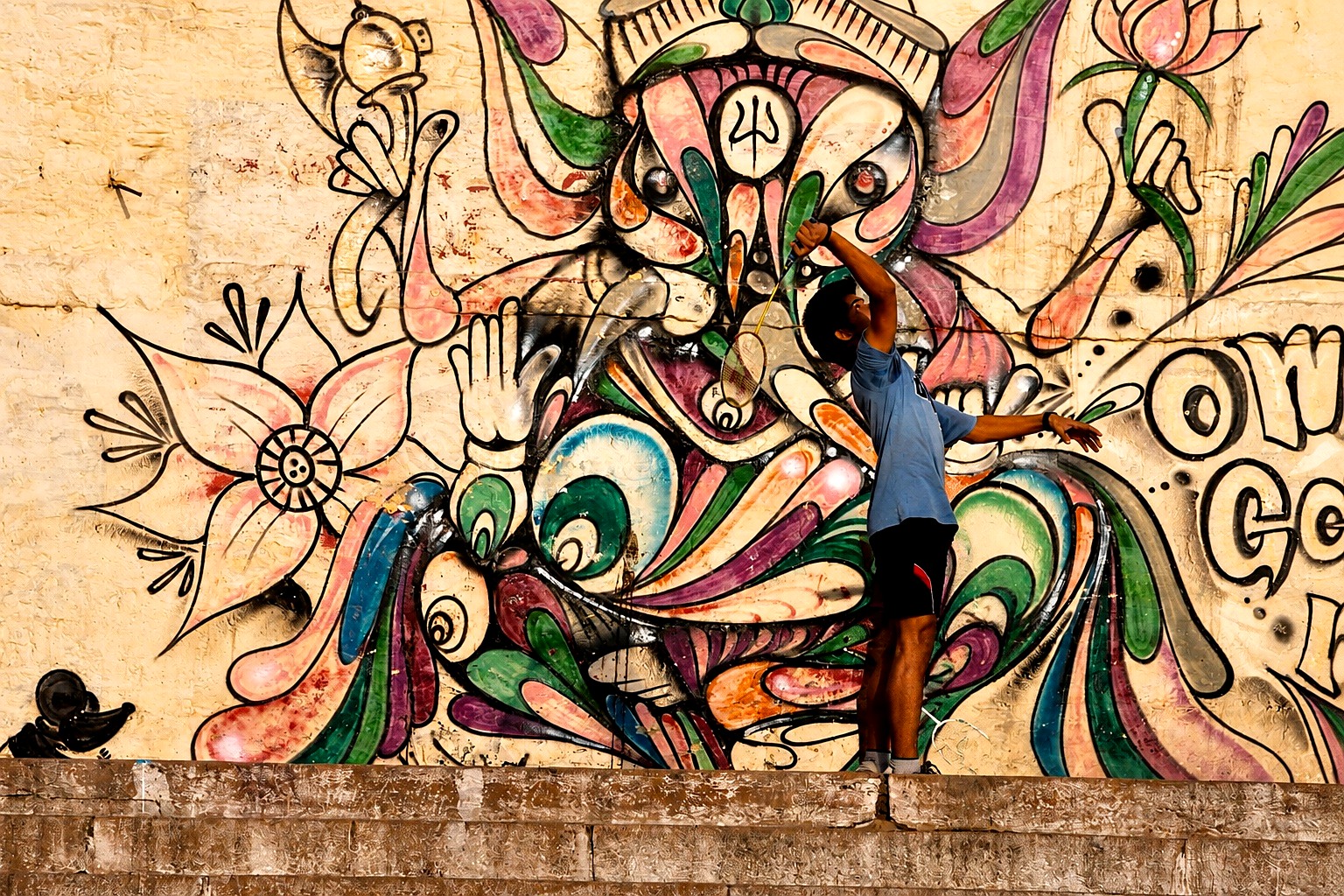
In Varanasi, I photographed a boy playing badminton. Years later, that photograph became the beginning of an extraordinary series of coincidences involving a music school, a composer, and an original musical composition.
In Khajuraho, a visit to a school introduced me to a teacher and his students, and to a way of organizing education quite different from what I had known in Canada.
On a roadside in Odisha, a gathering around a small fire led to an unexpected encounter with a ceremony I had known nothing about.
These experiences reminded me that the most interesting part of travelling is often what happens when the itinerary gives way to curiosity.
And sometimes a photograph becomes more meaningful long after the moment in which it was taken.
Colour, black and white, and the photograph
I have always been especially attracted to black-and-white documentary photography.
Perhaps that reflects the influence of the photographs I admired in Life magazine. There is something about the absence of colour that can direct attention to expressions, gestures, light, shadow, and the relationships between people.
Yet India also taught me to appreciate the extraordinary possibilities of colour.
Its painted buildings, streets, clothing, architectural details, and changing light are frequently essential to the photographs themselves.
I do not believe that one approach is inherently superior to the other.
Some photographs may communicate more effectively in colour. Others may become more compelling in black and white.
What matters is whether the treatment strengthens the photograph without distracting from the moment it records.
The photograph must always come first.
The extraordinary lives of ordinary people
The idea behind Everyday Lives is quite simple.
I have come to believe that there is something worth discovering in the lives of people we encounter every day, even when their circumstances are very different from our own.
A child on the way to school. A vendor arranging merchandise in a market. A musician practising. A family gathering. Someone absorbed in work.
These are not necessarily exceptional events.
But the people experiencing them are individuals, each with a life, a history, and circumstances that we may know very little about.
Photography offers an opportunity to observe something of their world.
It does not necessarily allow us to understand that world fully. A photograph is only a fragment of a life, and the photographer is often a visitor with a limited perspective.
That limitation matters.
I hope these photographs encourage curiosity rather than assumptions, and appreciation rather than judgment.
Why Everyday Lives exists
Everyday Lives began with my desire to bring together photographs accumulated over many years of travel and give them a more meaningful purpose.
But I increasingly regard it as something more than a photographic collection.
I want it to become an archive of human encounters and observations, presented through photographs, stories, and, where appropriate, sound and moving images.
Some stories may be told through a single photograph. Others may require a sequence of images and an accompanying narrative.
Not every country will be represented equally, and not every photograph will have a story attached to it.
That is as it should be.
The ambition is not to create a comprehensive record of the countries I have visited. It is to share selected glimpses into the lives of people I have encountered.
I return often to the photographs that fascinated me as a child.
What made them memorable was not simply where they were taken or how technically accomplished they were. It was their ability to make me interested in someone else's life.
If Everyday Lives can occasionally give another person that same experience, it will have accomplished something worthwhile.
Brian E. Silver
Everyday Lives Documentary Archive