Photography and text are prioritized. Interactive geographic context loads only when needed.
Journey Through India
Varanasi Life Along the Ganges
Along the riverfront of Varanasi, sacred practice and day-to-day life occupy the same public spaces: prayer, work, bathing, conversation, movement and ceremony unfold against the Ganges and the stepped ghats.
A living riverfront shaped by faith, work and daily life.
Varanasi — also known as Banaras, Benares and Kashi — is a city in Uttar Pradesh whose cultural identity is inseparable from the Ganges. It is widely described as one of the world’s oldest continuously inhabited cities and has long been a major centre of Hindu pilgrimage, learning, music, craft and trade.
Its riverfront is formed by a long sequence of ghats: flights of stone steps that connect the city to the water. The ghats are not a single monument. They were built and rebuilt across centuries and remain active public spaces for bathing, prayer, offerings, festivals, conversation, labour and, at designated ghats, cremation.
The photographs in this journey were made in 2014. They record what was encountered during one visit rather than attempting to provide a comprehensive portrait of the city. Historical and cultural context is kept distinct from photographic observation so that the images are not forced to illustrate claims they cannot themselves establish.
Place & photograph
Along the Varanasi riverfront
Explore selected places represented in the photographic journey. The markers identify verified named places, not the photographer's exact camera position.
01 · First visit · 2014 · Arrival
Arrival
Before sunrise, the riverfront begins to gather movement.
Morning in Varanasi often begins at the water. Boats move into position, priests and worshippers arrive, and routines that are religious, social and practical begin to overlap on the steps.
For this archive, dawn is not treated simply as atmosphere. It is the first change of tempo in a public landscape that will remain active throughout the day.
Boats gather on the Ganges in the early morning. — Varanasi, 2014 · V-2014-462Young priests on the riverfront at dawn. — Varanasi, 2014 · V-2014-463Young priests and red mats create a repeating morning pattern on the ghats. — Varanasi, 2014 · V-2014-464Kedar Ghat in the early morning. — Varanasi, 2014 · V-2014-470A wider view of the Jain-associated riverfront. — Varanasi, 2014 · V-2014-547
02 · First visit · 2014 · The River
The River
The Ganges is simultaneously sacred river, working environment and public horizon.
In Hindu tradition the Ganga is sacred, and Varanasi is one of the places where that religious relationship is most visible. Ritual bathing, prayer and offerings take place at the same water used for transport, washing, work and everyday movement.
The photographs therefore avoid separating a “religious” river from its day-to-day uses. In Varanasi, those meanings frequently occupy the same frame.
Morning ablutions beside the Ganges. — Varanasi, 2014 · V-2014-468A woman in a red sari prays beside the Ganges. — Varanasi, 2014 · V-2014-515A river offering near the Man Mandir area. — Varanasi, 2014 · V-2014-579Bathing in the Ganges. — Varanasi, 2014 · V-2014-607A solitary swimmer surrounded by the broad surface of the river. — Varanasi, 2014 · V-2014-613An older man bathes beside the stone steps. — Varanasi, 2014 · V-2014-614
Morning on the Ganges — V-2014-654
03 · First visit · 2014 · The Ghats
The Ghats
Stone steps turn the edge of the river into architecture, geography and public space.
A ghat is a stepped approach to the river. Along Varanasi’s riverfront, named ghats form an extended architectural sequence of stairs, platforms, temples, palaces, houses and passages. They were constructed and rebuilt at different times, often with patronage from rulers and communities elsewhere in India.
Kedar, Karnataka, Rana Mahal, Munshi, Dashashwamedh and other ghats appear in the 2014 photographs not as isolated monuments but as places whose architecture is continually activated by people.
People cross the striped steps of Karnataka State Ghat. — Varanasi, 2014 · V-2014-504Rana Mahal Ghat, where architecture and daily movement share the frame. — Varanasi, 2014 · V-2014-567Munshi Ghat and its riverfront architecture. — Varanasi, 2014 · V-2014-568Dashashwamedh Ghat, one of the best-known ritual centres on the riverfront. — Varanasi, 2014 · V-2014-576Varanasi, 2014 · V-2014-602Varanasi, 2014 · V-2014-633Varanasi, 2014 · V-2014-634
04 · First visit · 2014 · Everyday Life
Everyday Life
Sacred space does not suspend day-to-day life.
Laundry, grooming, transport, commerce and personal care occur beside prayer and ritual. The proximity is not an editorial contrast imposed by the archive; it is one of the recurring conditions visible along the riverfront.
This chapter keeps those routines at human scale. A bicycle loaded for work, cloth washed at the river, a haircut and a shave belong to the same documentary landscape as shrines and worship.
Morning hygiene beside stacked wood on the ghats. — Varanasi, 2014 · V-2014-498Dhobi workers wash cloth beside large wooden boats. — Varanasi, 2014 · V-2014-621aVaranasi, 2014 · V-2014-626Varanasi, 2014 · V-2014-642Varanasi, 2014 · V-2014-648A cargo bicycle carries heavy metal containers through Varanasi. — Varanasi, 2014 · V-2014-112A close shaving scene on the ghats. — Varanasi, 2014 · V-2014-667
A haircut on the painted ghat steps — V-2014-512
05 · First visit · 2014 · Encounters
Encounters
The journey narrows from the riverfront as a whole to individual moments within it.
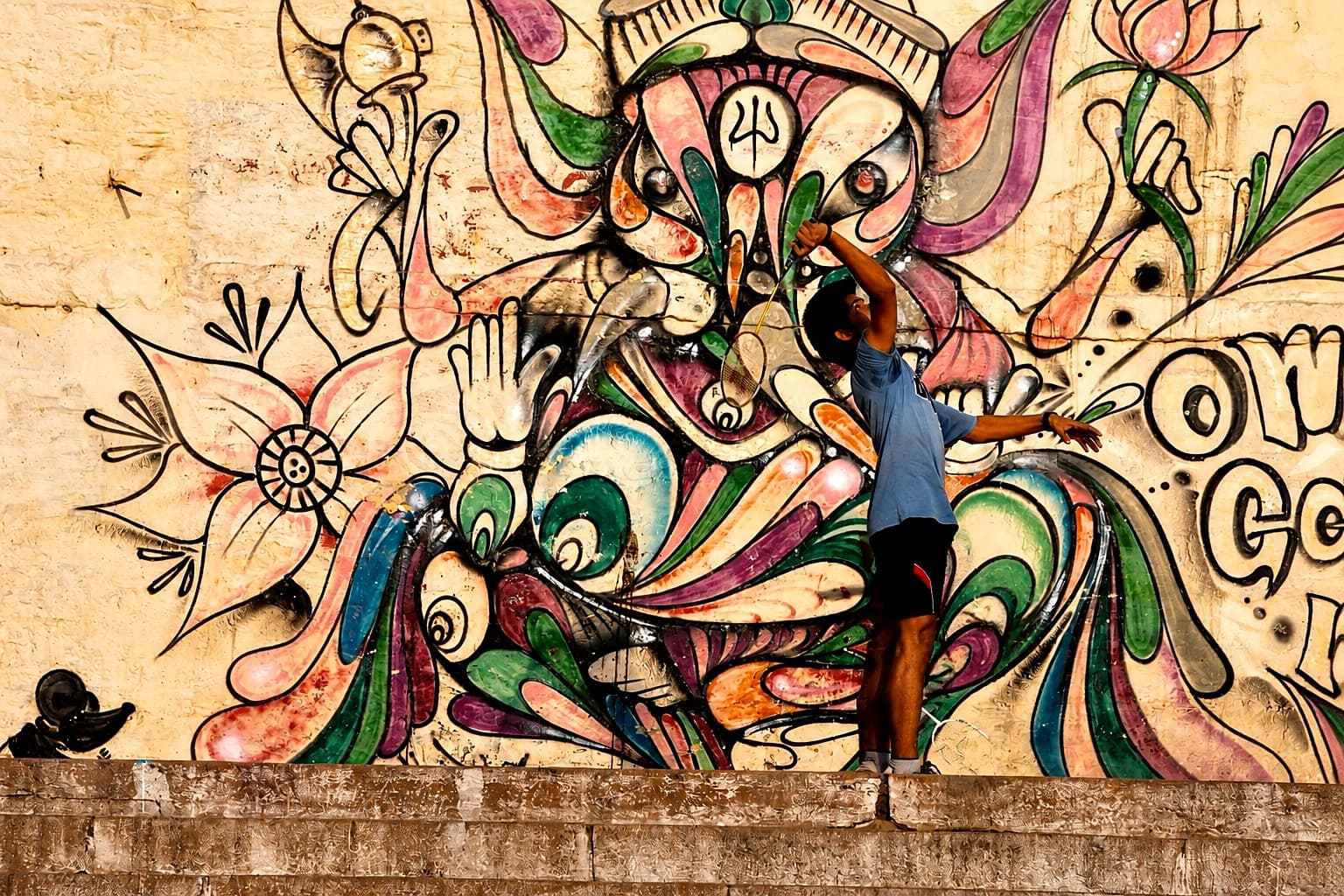
Some encounters are immediately legible; others are not. A man prays at a shrine, another sits in meditation, and a holy man rests at the water’s edge. In the photographs of boys practising together on the steps, the exact nature of the activity is not established by the archive, so the description remains deliberately observational.
This restraint is part of the documentary method: when a person’s identity, intention or practice is not known, the website should not manufacture one.
Prayer at a small shrine framed by a weathered blue doorway. — Varanasi, 2014 · V-2014-122Boys practise together on the steps; the exact activity is not identified in the archive. — Varanasi, 2014 · V-2014-484Varanasi, 2014 · V-2014-605
An elephant and an auto-rickshaw share the street: an unexpected Varanasi encounter. — Varanasi, 2014 · V-2014-704
06 · First visit · 2014 · Reflection
Reflection
Distance and quiet restore the scale of the river.
A solitary swimmer or a single figure in prayer can become very small against the width of the Ganges and the mass of the stone riverfront. These quieter images create a pause before the intensity of evening ritual.
The pause is structural as well as visual. The website should allow the viewer to spend time with an image rather than move continuously through information.
A man sits in meditation on a riverfront platform. — Varanasi, 2014 · V-2014-474A seated holy man at the water’s edge. — Varanasi, 2014 · V-2014-616Varanasi, 2014 · V-2014-656Varanasi, 2014 · V-2014-678Varanasi, 2014 · V-2014-681
A woman in an orange sari stands in prayer on the stone ghats — V-2014-641
07 · Evening Aarti
Evening Aarti
At dusk, coordinated movement, light and sound transform the riverfront.
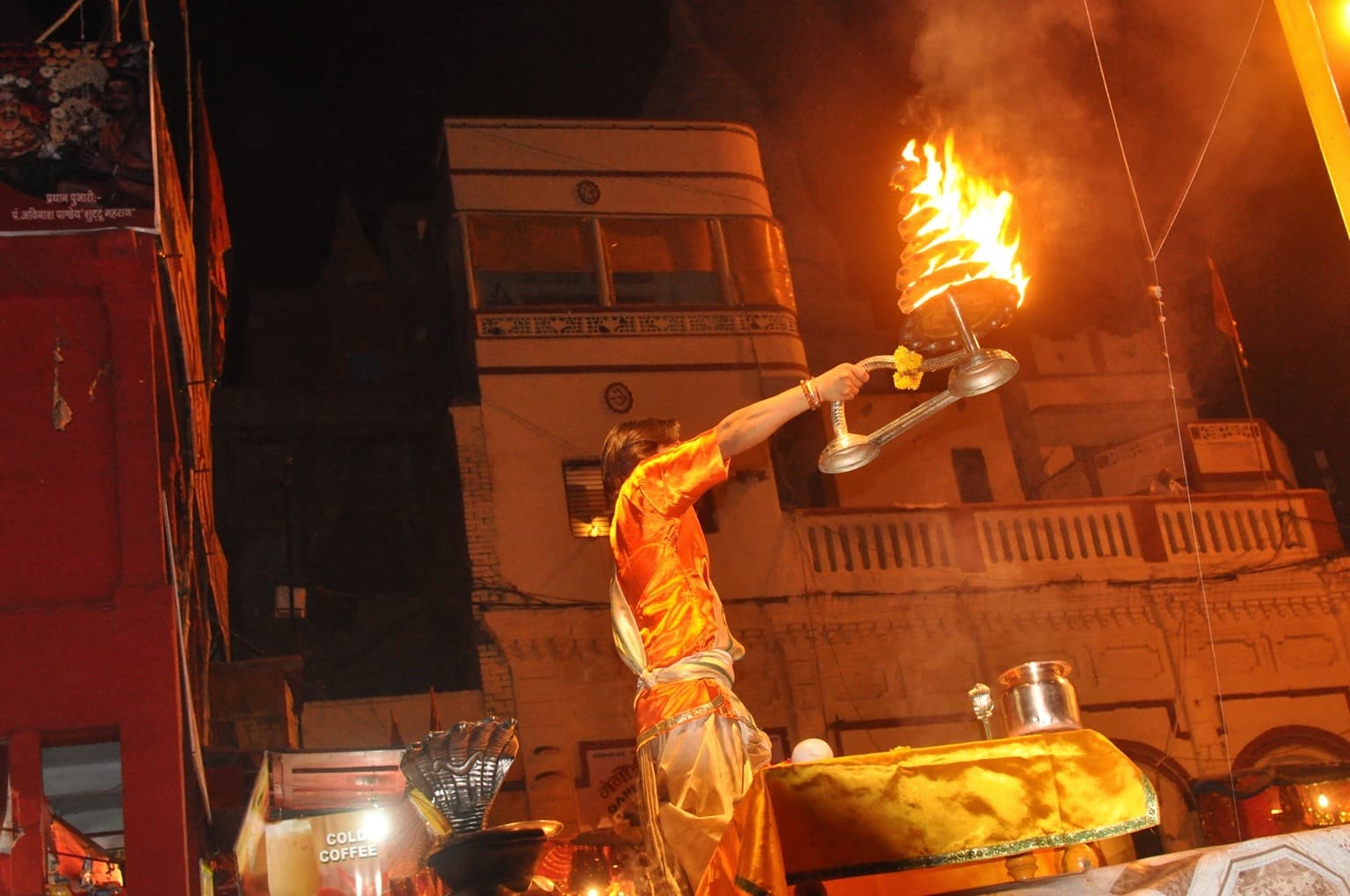
Ganga Aarti is a daily ritual of reverence to the river, performed at Dashashwamedh and other ghats. Priests use lamps, incense and coordinated gestures while bells, conch shells, cymbals and mantras contribute to the ceremony’s soundscape.
The photograph shown here records one evening in 2014. It represents a moment within a continuing ritual rather than a complete explanation of the ceremony.
Five years later, the return follows a single arc from morning river to illuminated night and back to open water. 176 photographs now carry the expanded guided sequence; every approved 2019 image remains available in the complete selection.
01 · Return to the river
The Ganges, encountered again
The return begins at a distance: morning haze, crossing boats and the first movement along the riverfront.
The layered riverfront seen through morning haze. — Varanasi, 2019 · V-2019-051
Morning traffic and birds on the river. — Varanasi, 2019 · V-2019-087
Family movement along the riverfront. — Varanasi, 2019 · V-2019-082
A boatman rows past riverfront temples and moored boats. — Varanasi, 2019 · V-2019-440
Temple architecture and working boats meet at the water’s edge. — Varanasi, 2019 · V-2019-552
A boatwoman moves steadily across the river. — Varanasi, 2019 · V-2019-554
Passengers cross the river in soft morning light. — Varanasi, 2019 · V-2019-558
A red boat anchors a crowded riverfront view. — Varanasi, 2019 · V-2019-607
Boats and birds spread across the pale morning river. — Varanasi, 2019 · V-2019-608
A close passenger boat sets contemporary river traffic against the crowded ghats. — Varanasi, 2019 · V-2019-613
Passengers and birds converge in a dense morning river scene. — Varanasi, 2019 · V-2019-615
A distant camel and rider cross the pale far bank of the river. — Varanasi, 2019 · V-2019-651
A boat, birds and the low sun create a quiet morning river scene. — Varanasi, 2019 · V-2019-661
A crowded river crossing places passengers directly against the dense ghats. — Varanasi, 2019 · V-2019-663
Sun, birds and a passing boat compress into a luminous river scene. — Varanasi, 2019 · V-2019-666
Architecture, boats and morning haze define the layered riverfront. — Varanasi, 2019 · V-2019-668
A solitary standing figure gives scale to the crowded riverfront beyond. — Varanasi, 2019 · V-2019-675
The river opens into a quiet field of sun, birds and passing boats. — Varanasi, 2019 · V-2019-677
The riverfront recedes through steps, boats and haze. — Varanasi, 2019 · V-2019-690
Working boats rest beneath a layered hazy riverfront. — Varanasi, 2019 · V-2019-692
Boats gather under a column of reflected morning light. — Varanasi, 2019 · V-2019-693
02 · At the water
Gesture, work and devotion
Bathing, washing and prayer unfold in the same shared space. Repeated gestures give the river its human rhythm.
A devotional act at the river. — Varanasi, 2019 · V-2019-042
Two women perform morning bathing at the river. — Varanasi, 2019 · V-2019-165
Bathing and washing animate the river’s edge. — Varanasi, 2019 · V-2019-559
Colour and repeated gesture shape a morning river scene. — Varanasi, 2019 · V-2019-561
Bathing, waiting and shared space gather at the water. — Varanasi, 2019 · V-2019-563
Many small acts of everyday life unfold together on the ghats. — Varanasi, 2019 · V-2019-595
Many small acts of bathing and preparation unfold together at the river. — Varanasi, 2019 · V-2019-633
Movement, bathing and conversation animate the waterline. — Varanasi, 2019 · V-2019-636
A closely observed moment of bathing and devotion at the river. — Varanasi, 2019 · V-2019-642
A child enters the river with the support of two women. — Varanasi, 2019 · V-2019-644
A stream of water catches the light amid the crowded bathing steps. — Varanasi, 2019 · V-2019-658
Bathing, prayer and everyday movement meet at the waterline. — Varanasi, 2019 · V-2019-664
The city has long traditions of Sanskrit learning, classical music, textile production, metalwork and other crafts. Banarasi silk and brocade are particularly associated with its commercial and artisan history.
Nearby Sarnath is central to Buddhist history as the place traditionally associated with the Buddha’s first sermon after enlightenment, while Varanasi also has important Jain associations. As additional photographs are prepared, the website can expand from the riverfront into these wider histories and lived environments.